Engine Tech Page
We
Now Accept Visa, MasterCard, Discover, and American Express!
Phone In Your Order At # 715-356-7346
TESTING, TESTING,
TESTING....
After motors are modified or rebuilt we test them on our engine stand.
The test stand can check charging systems, oil systems etc. Valves and cam
chains are reset after running so everything is perfect.
The test stand has a special feature. We have a separate oil tank that is pressurized
with air which forces oil into the important oil cavities for initial start up.
After the motor develops its own oil pressure this pressurized tank is shut off.
(cool hey?) This feature is very important because of obvious reasons. Shown is
a customers engine getting ready for shipping.
HONDA SOHC MOTOR WORK
This section will show you step by step
how to build your motor. We will have two versions of a
rebuild : Full mod - but streetable, and stock - but more aggressive.
This section is long over due
but worth the wait! Ken will be working on this for the rest of the week, so check
back.
Performance gains can be made with out complete motor tear down and without some
expensive reinforcement of motor components.
Because we like the power potential of Honda SOHC's and we like to drive fast so
we
will start this motor section with our recommended high performance upgrades.
Before we go any further, Some motors we have seen have led a hard life. If you
have a motor that has never had a oil change and has been abused for 30 plus
years find a new one. If your crank journals are worn or scuffed and every gear
and bearing is unusable, things can get to expensive.
Crankshafts
are lightened, Balanced,
micro polished and fluted for oil flow. This procedure will give you very
noticeable acceleration and rev potential. Any loss of flywheel effect will be compensated
by your big bore kit. (balanced for sustained 14,000 rpm)
Pistons are balanced perfect. (We will talk about pistons later)
Nearly every high performance builder or catalog from the 70's talks
about heavy duty connecting rods.
Rod breakage is an established possibility in high performance CB's. Maybe the
single biggest weak link when run hard. (stretching slightly and breaking)
Detonation is the prime cause of rod breakage. Modified motors (any motorcycle)
is prone to detonation now and then. High performance rods are extra insurance
against motor problems.
Connecting rods (whichever brand) are balanced. All your rods may weigh the
same, but some could be heavier at the big end and others at the small end. Rods
should be balanced one half at a time. There is a difference between rotating
and reciprocating weight.
3rd photo shows the difference in stock and high performance con-rods.
If you are curious, stock rods weigh 358 grams, steel rods weigh 385 grams and
alloy weigh 273 grams.
Rod bearings and main bearings need be checked
for proper clearance. This is done with Plastigage.
Honda factory manuals are best for this procedure.
After bearings are checked and addressed as necessary, clean thoroughly. Cleanliness is next to
godliness.
Notice the new primary chains and heavy duty cam chain.
TIP: Soak chains in oil overnight so the oil penetrates the links (They last
longer).
Get an accurate torque wrench and proceed to assemble your bullet proof
crankshaft.
Transmission is now inspected
thoroughly. (Gears, forks, shift drum)
The only problem experienced with the Honda transmission is they will jump out
of third gear.
Modified Honda motors must have the third and forth gears removed and
undercut. This undercut procedure will insure the trans will lock in gear with
no chance of jumping out of gear.
TIP: During inspection of the trans, blued shift forks are a obvious sign there
is a problem. Keep in mind that the shift forks move gears, not hold
gears in place.
CLUTCH Plates are soaked in oil with the chains. We like the extra plate clutch
kits.
CYLINDER studs (heavy duty) are installed. We install these heavy duty studs
on all motors (even stock motors).
SEALS are installed.
GASKET SEALER. We only use ThreeBond 1104 sealer for case halves. Please do not
use silicone sealer.
CAMSHAFTS:
Stock motors can benefit from a mild
camshaft, power increases will be noticeable and you will not need to be concerned
about piston to valve intersection. Springs will also not be needed.
We like a mild road-race cam used on small tracks. Call
for specifies cam profile.
Hotter cams will need valve relief (piston's)
heavy duty springs, etc.
Cams, can and should be chosen for specific styles of riding. High RPM cams have
more duration.
More duration will generally give you more top end power but you might
loose some power at low RPM. Choose your cam accordingly.
Camshafts are a touchy subject and should be selected by someone with
experience.
OK, here's your tech tip:
Degree-ing your new camshaft can mean up to a half a second on the drag strip.
Just like your rear chain, cam chains stretch. This means that if you install
your camshaft with a stretched chain and do not degree properly, you have just
wasted your time.
Some people years ago would even grind their stock camshaft sprocket (oblong the
mounting holes) and bump the cam back to stock spec's to compensate for cam
chain stretch. (noticeable difference)
For really aggressive profiles, welded then reground camshafts are more durable
than billet shafts.
When we install a full race camshaft in this motor, we will show you how to degree
a cam.
TO BE CONTINUED:
MORE MOTOR WORK, TECH TIPS AND PRICING.
We will need to take more pictures to show this motor
being assembled. After this lengthy
section is done we will take this
motor in a assembled bike
to a Dyno to prove
the horsepower potential of our fighter motors.
F-2 vs. K Model SOHC Motors.
Before you consider modifying your F-2 motor,
we would like to tell you a few things to help with your decision to go faster.
True that F-2 motors made a few upgrades to compete against the Kawasaki's years
ago, (heavy duty counter shaft bearings, lighter alternators, larger valves,
heavier valve springs etc) but consider this, the valve train is a weak link on
the F-2's. The valve retainers are prone to failure (must use titanium) dropping
the valve into the motor causing huge damage.
The oversize valves create a potential problem with race cams (higher lift and
longer duration). Valve intersection is almost certain. (so check carefully)
Honda "K" motors have the potential of making big power and great
reliability. The F-2 motor can be made to run with big bore kits, cams, etc. But
pay attention to some above mentioned facts.
Most engine builders will replace the F
head assembly with a "K" head assembly. ( cylinders and head must be
changed together)
Anyway, the F-2 combustion chamber is larger and deeper for the over size
valves.
The chamber is about 18% bigger. This means if you have 10 1/2 compression
pistons on a F-2 model head your compression ratio will be approx
one point less or so.
There are a couple of other differences, but hope this helps somewhat.
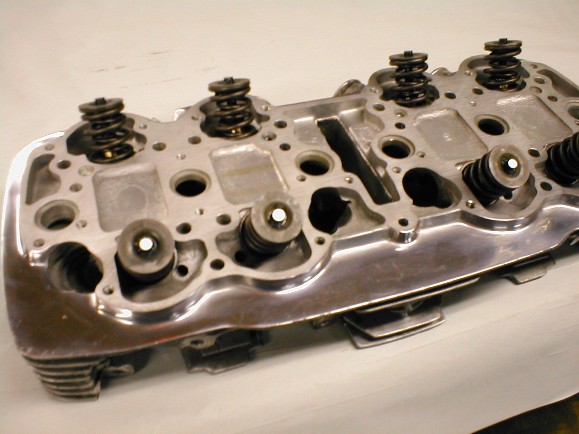
THE KEY TO A GOOD RUNNING MOTOR IS THE HEAD. IF YOUR VALVES HAVE A POOR SEAL, THERE IS NO IGNITION OR CARB SYSTEM IN THE WORLD THAT CAN HELP.
SHOWN ABOVE IS ONE OF OUR STREET FIGHTER HEADS.
LABOR:
DISASSEMBLE HEAD
GLASS BEAD PORTS
PRESS OUT VALVE GUIDES
STREET PORT THE HEAD (DRAG RACERS WILL REQUIRE MORE WORK)
SURFACE BOTH SIDES OF THE HEAD
INSTALL NEW VALVE GUIDES
REAM GUIDES
GRIND VALVES (NEW OR USED)
MULTI ANGLE VALVE JOB
CLEAN AND REASSEMBLE
DEPENDING ON CARBS, PIPES ETC. PORTED HEADS CAN GIVE YOU
UP TO 10% ADDITIONAL POWER.
WE ALWAYS TRY TO HAVE HEADS IN STOCK ON A EXCHANGE BASIS
LABOR $ 385.00 , PARTS ARE EXTRA, OF COURSE